


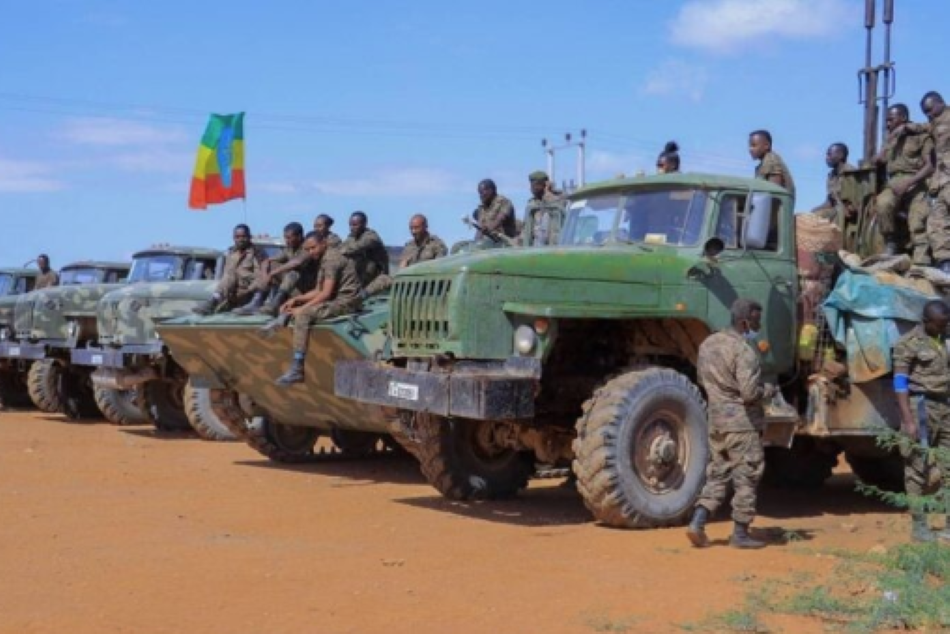
Following the sudden withdrawal of TPLF forces, the National Defense Force and the allied “Peace Force” militia took full control of the city. Communications have been restored, shops remain closed, and residents are organizing their own security. Meanwhile, Egypt, Eritrea, Somalia, and Sudan meet in El Alamein, calling for “political and peaceful solutions” to the crisis.
Giorgos Papagiannis | 05.10.2026 world
Ethiopian federal forces entered Mekelle, the capital of the Tigray region, on Saturday afternoon without encountering resistance. According to local sources who spoke to Agence France-Presse, leaders and fighters of the Tigray People’s Liberation Front (TPLF) had already abandoned the city, leaving a power vacuum behind. By Sunday, National Defense Force (ENDF) troops were patrolling the streets and staffing key institutions, alongside the “Peace Force in Tigray,” a local militia made up of former TPLF fighters who now support the government of Abiy Ahmed.
The capture of Mekelle unfolded in two phases
On Friday, the allied militia announced it had seized Alula Aba Nega Airport, about ten kilometers outside the city, which had been under rebel control since September 23. On Saturday, forces advanced into the city itself, which had been abandoned by TPLF fighters. The reasons for the withdrawal have not been officially clarified, though some sources speak of a decision to avoid destroying the city, while others describe it as a tactical retreat ahead of guerrilla warfare.
The return of Mekelle to central government control marks a new phase in the conflict that erupted again on September 21, when the TPLF and its allies launched attacks on multiple fronts, initially seizing the airports of Mekelle, Shire, and Axum. The federal counteroffensive was swift: within days they retook Alamata and pushed north, reaching the outskirts of the regional capital.
The situation in Mekelle remains fluid
Telecommunications were restored on Sunday, after more than a week of disruption. Shops and businesses remained closed, as owners had moved their stock to safer locations, fearing looting. “There is no police,” a resident told Agence France-Presse, speaking on condition of anonymity. “Last night we had to organize ourselves for our own safety.” Another resident, who also wished to remain anonymous, said that “the fact that the intensity of the war is beginning to subside brings some immediate relief,” but added that he fears the conflict “will be prolonged.”
The government of Abiy Ahmed has not issued an official announcement
However, Abraham Belay, former head of the administration appointed by the federal government in Tigray, told state news agency ENA that efforts are underway to create a new administrative structure in the region, which will allow regional elections to be held “within a few months.” At the same time, he accused Eritrea of supporting the TPLF, describing its forces as “anti-peace.”
TPLF leader Debretsion Gebremichael, in a video message on Thursday, had stated that his forces are in a “defensive phase” and will shift to guerrilla warfare. “We operate with a strategy of hitting the enemy where we choose,” he said, recalling that in 2021, after the fall of Mekelle in the first war, the rebels had managed to retake it.
Meanwhile, in the Egyptian city of El Alamein
The presidents of Egypt, Eritrea, Somalia, and Sudan met on the sidelines of an African business forum. According to a joint statement, the four countries – which maintain periodically tense relations with Ethiopia – called for the resolution of regional disputes through “political and peaceful solutions.” Egyptian President Abdel Fattah el-Sisi stated that Egypt opposes foreign intervention in African states and called for relations based on “mutual respect, good neighborliness, and dialogue, away from unilateral policies.” His remarks come within the context of the long-standing Egypt–Ethiopia dispute over the Blue Nile dam.
The capture of Mekelle does not mean the end of the conflict. On the contrary, it raises questions about the next phase: whether the TPLF will shift to guerrilla warfare, whether Eritrea will become directly involved, and whether the regional crisis will escalate into a broader conflagration in the Horn of Africa. For the residents of the city, the answer lies in their daily lives: without police, with shops closed, and with the threat of a war that, as one of them says, “may be prolonged.”