

The rejection of two decrees on the housing crisis by the People’s Party, Vox and the Catalan separatists of Junts opened the path to early elections. Spanish Prime Minister Pedro Sánchez, in a televised address from Moncloa Palace, announced the dissolution of Parliament. Polls give the People’s Party and Vox over 200 seats, leaving the left at historic lows.
Giorgos Papagiannis | 05.10.2026 world
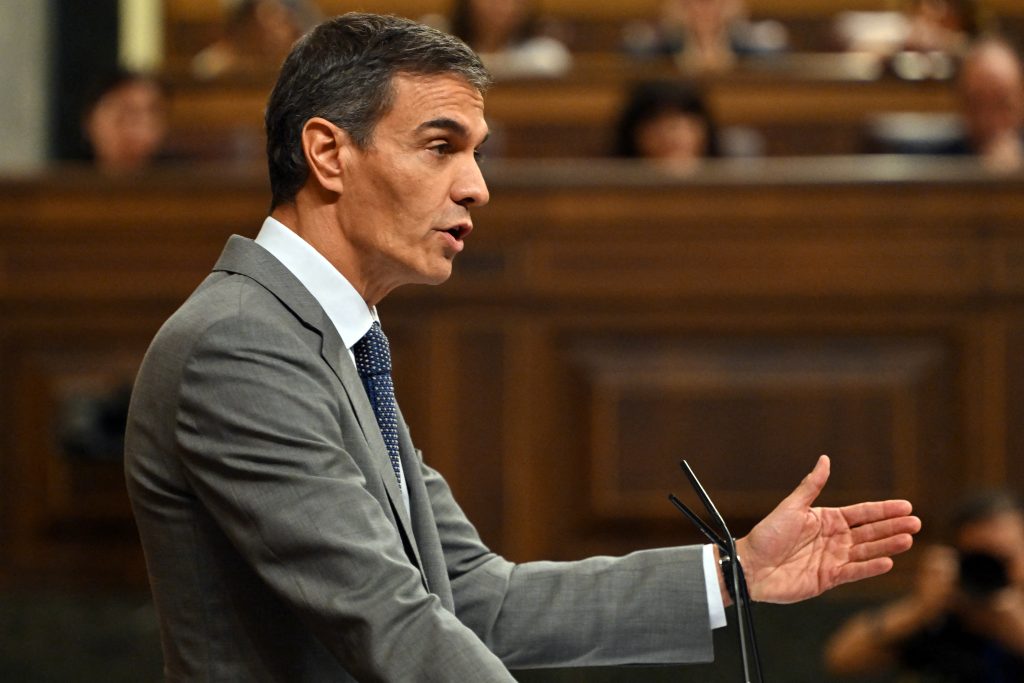
Pedro Sánchez announced on Monday the dissolution of the Spanish Parliament and the calling of early elections for November 29. The decision came after the government’s heavy parliamentary defeat last Friday, when the Congress of Deputies rejected two emergency decrees on the housing crisis.
The first decree provided for the suspension of evictions for vulnerable households and a ban on property purchases by “vulture funds” (funds that buy homes at bargain prices to resell them). The second included tax incentives for owners who make properties available at affordable prices. The decrees had been approved by the cabinet on Tuesday, but were voted down by the People’s Party (PP), the far-right Vox and the Catalan separatists of Junts, while the Basque PNV said it would vote against one of the two.
The trigger for public anger was the case of 87-year-old Marikarmen Abascal. The eviction of the elderly woman from her apartment in Barcelona sparked mass protests across the country, with thousands of citizens demonstrating daily demanding “fair rents, no evictions.” The name “Marikarmen” became a symbol of the housing crisis that has plagued Spain in recent years, with rental prices soaring in Madrid, Barcelona and tourist areas.
Sánchez, who had stated from the beginning of his term that he would serve the full four years, was forced to change course. On Friday evening, after the decrees were rejected, he told Parliament: “History will judge you much sooner than you think.” Meetings with ministers and PSOE officials followed throughout the weekend, and on Monday morning he announced his decision from Moncloa Palace.
If Sánchez signs the decree dissolving Parliament on Monday, it will be published in the Official Gazette (BOE) on Tuesday, and the 54 days stipulated by the electoral law will begin to count, leading to the polls on November 29.
What the polls show
The polls, however, are not favorable to Sánchez. According to the average of surveys published by El País, the People’s Party of Alberto Núñez Feijóo leads with about 33% of the vote, followed by PSOE with 26%, Vox with 18%, Sumar with 6% and Podemos with 3%. The latest SocioMétrica poll for El Español gives PP 143 seats, PSOE 106, Vox 62 and the new “Broad Front” (the successor to Sumar) 6 seats. PP and Vox together gather 205 seats, 29 above the 176 required for an absolute majority.
The shift to the right is striking. In 2019, the right-wing parties (PP, Vox and Ciudadanos) gathered 43% of the vote, exactly the same as the left (PSOE, Podemos and Más País). In the 2023 elections, the right won with 45% to 44%. Today, the average of polls gives the right about 52% and the left 36% — a 16-point gap, the largest ever recorded. Vox is the party that has grown most, from 12% in 2023 to 18% today, while PP remains stagnant at 33%.
The reaction of the parties
Within the Socialist ranks, the view prevails that going to the polls is inevitable. PSOE sources said the probability of early elections is “99%” after the rejection of the decrees. Consumer Affairs Minister Pablo Bustinduy said the party is “ready” for an electoral contest that will serve as a “referendum on housing.” Deputy Prime Minister Yolanda Díaz remained tight-lipped, saying the decision “belongs to the prime minister.”
In the opposition, PP’s Feijóo has been calling for early elections for months. Feijóo said on Friday: “I am ready.” Vox’s Santiago Abascal calls for a “national restoration” and has already begun preparing its campaign platform. The Catalan Junts, which played a decisive role in the rejection, has not yet officially commented on the election outcome, but its leader Míriam Nogueras said her party “will respect the popular verdict.”
For Sánchez, the decision is extremely risky. If the polls are confirmed, he will lead PSOE to its worst electoral performance since 2016 and hand power to a PP-Vox coalition government, the first far-right participation in a Spanish government since the transition to democracy. On the other hand, prolonging uncertainty and continuing a minority government would mean even greater erosion, with housing protests continuing and public discontent growing.
The November 29 elections will decide not only the fate of the Sánchez government, but also Spain’s course in the European Union, at a time when the country has emerged as a key partner of Germany and France in shaping European policy on migration, energy and economic governance. The rise of the right in Spain, combined with political turmoil in France, could change the balance in Europe in the coming months.