


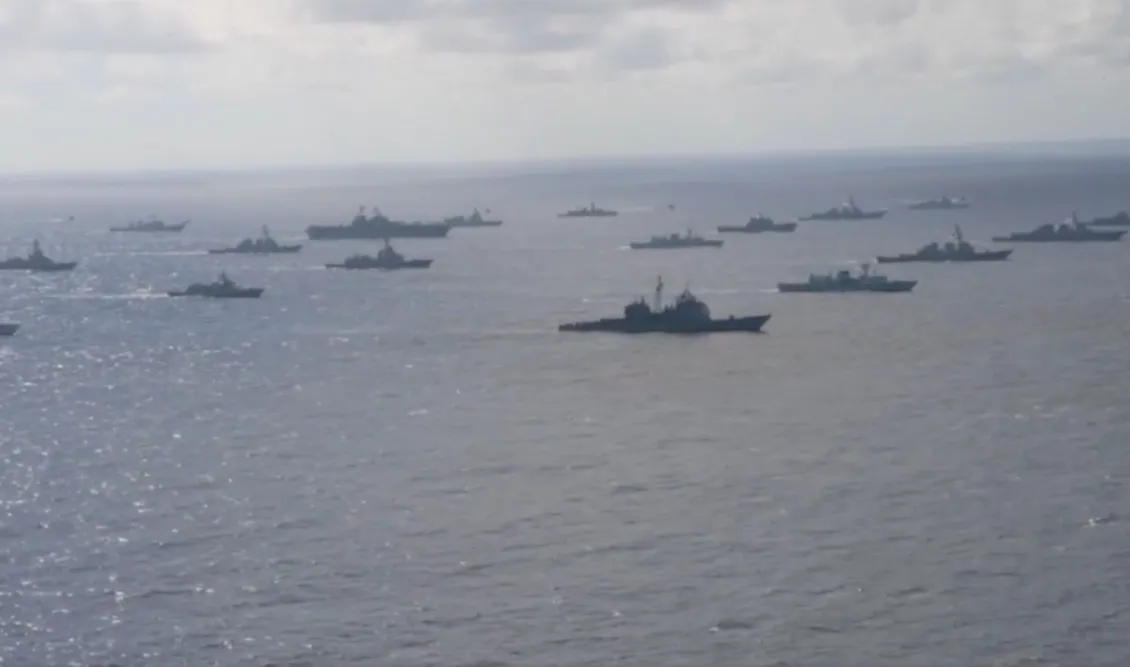
The Pentagon is moving the USS Theodore Roosevelt carrier strike group and the “Makin Island” amphibious group to the region, boosting the US military presence to over 60,000 troops. The moves come just before the November 3 midterm elections, with the American president leaving open the possibility of escalating strikes against Tehran after the vote. Officials deny this necessarily means preparing for war, but acknowledge that planning is underway.
Giorgos Papagiannis | 02.10.2026 International
The Pentagon is deploying a third carrier strike group and additional Marine Corps ships to the Middle East, adding 9,000 to 10,000 troops to the region. The move, revealed by the Wall Street Journal and confirmed by US officials, comes as Donald Trump declares it is “possible” he will expand the bombing campaign against Iran after the November 3 midterm elections.
According to the report, the three carrier strike groups are expected to assemble approximately 20,000 troops and up to 150 fighter jets, along with a significant number of destroyers capable of launching missiles and countering missile attacks. Currently, about 50,000 US troops are already deployed in the broader region.
The ships being moved are the USS Theodore Roosevelt, which departed San Diego on September 27, and the “Makin Island” amphibious group, which followed a day later. Already in the region are the USS George Washington, which arrived in the Middle East in August, and the USS George H.W. Bush, which departed Virginia in March. According to one official, it is possible that three aircraft carriers will be in the region by late October.
Officials clarify that the moves are still in the planning stage and that no final decision has been made on their implementation. They also note that the new ships may be used to replace units that have been at sea for months – particularly if Trump ultimately decides not to expand the conflict. The USS Abraham Lincoln, for example, was in the Pacific on Thursday, returning to San Diego after a long deployment in the Middle East, where complaints had been raised about living conditions and the limited number of port calls.
In an interview published Thursday in Time magazine, Trump was asked whether he intends to intensify the bombing campaign against Iran after the elections. His answer was one word: “Possible.” The American president declined to discuss potential targets, but stated that the US has spent the past six months replenishing its weapons stockpiles to levels that, as he put it, have never been seen before. At the same time, he rejected Iran’s latest peace proposal, deeming it insufficient.
The war began on February 28, in coordination with Israel. A temporary pause in hostilities followed in the summer, as part of negotiations between Washington and Tehran for a permanent peace agreement. The talks collapsed, and both sides continued to exchange sporadic attacks.
According to an Axios report, the Trump administration recently also deployed two additional “Patriot” systems to Saudi Arabia and Qatar, to protect oil and energy infrastructure. These moves are part of a broader military buildup which, as analysts note, aims to give the president and military leadership greater flexibility in managing the war.
The deployment of three aircraft carriers does not necessarily mean that an expansion of the war is being prepared. It does mean, however, that the White House wants to have the option. And at a time when the midterm elections are approaching, a display of force in the Middle East can also serve as a message domestically: that the president is not finished with Iran, even if public attention is focused elsewhere. The coming period will show whether the reinforcement of forces will serve as a prelude to a new escalation or simply as a replacement of exhausted units. For now, the gap between Trump’s statements and the Pentagon’s moves remains the most contentious point of the affair.