

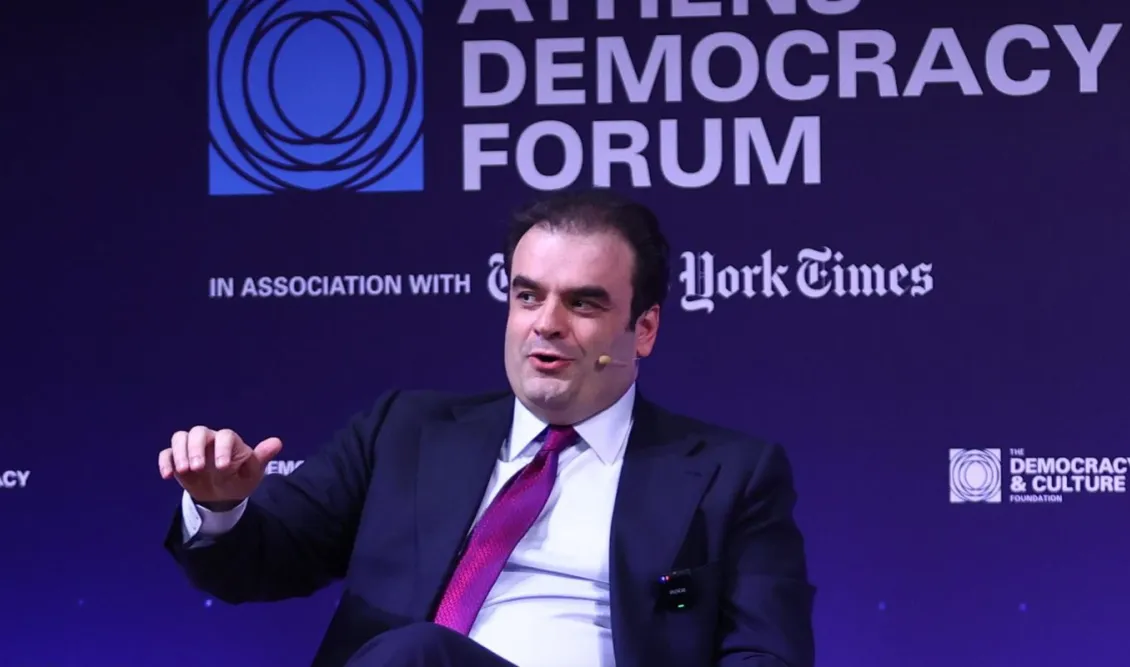
Speaking at the Athens Democracy Forum with New York Times columnist Thomas Friedman, the Minister of National Economy and Eurogroup President described a state running behind technology. “Change is exponential, but our perception is linear,” he said. At the same time, he revealed that Greece has already passed the national framework for the European AI Regulation, being among the first EU member states to do so.
Giorgos Petridis | 02.10.2026 Economy
The Athens Concert Hall hosted a discussion that went beyond the usual framework of a political public appearance. Kyriakos Pierrakakis, Minister of National Economy and Finance, sat across from Thomas L. Friedman, the New York Times columnist, in a session titled “A.I. vs. The World.” The dialogue did not revolve around what Greece would do. It revolved around what no country can do alone.
Friedman opened the discussion by posing a grim scenario. He expressed the fear that at some point humanity will be confronted with a “September 11 of Artificial Intelligence.” Such an event, he warned, could discredit the technology as a whole, even if it offers enormous benefits in agriculture, medicine, materials science, and energy. The greatest tragedy, he added, would be to have created a tool capable of solving every major challenge of humanity and to be unable to use it because we cannot overcome our dividing lines.
Pierrakakis responded with an observation that constitutes, in essence, a silent admission of weakness.
“No country in the world is large enough to regulate Artificial Intelligence on its own.”
The issue, as he put it, is not only technical or legal. It is structural. Our institutions are not designed for the era of Artificial Intelligence. And that is because technology moves at a pace that decision-making mechanisms cannot follow. “Change is exponential, but our perception is linear,” he stressed, describing a gap that is not merely technological but deeply political.
The minister did not stop at the observation. He also described the deadlock in the debate around AI. “We focus more on vocabulary than on implementation,” he noted, implying that international discussions often end up in declarations without substance. He even characterized institutions as “the software of our societies” – software that, as he said, needs redesigning and upgrading, not just security updates.
Pierrakakis’ remarks did not remain at the level of general principles. He answered questions on specific aspects of AI, including cybersecurity. He warned that AI systems will be able to identify vulnerabilities in infrastructure with a speed and scale that were not feasible in the past, making the protection of networks even more critical. At the same time, he spoke of the need to digitize the state, ensure interoperability of public systems, and leverage data, so that governments can respond to citizens’ needs in a way that justifies their existence.
The most interesting moment of the discussion, however, was the one that revealed the distance between words and actions – or, better, the attempt to bridge that distance. Pierrakakis, as Eurogroup President, has already put the issue of artificial intelligence on the table of the eurozone finance ministers. In July, he had called for the creation of a special working field on AI, arguing that Europe must develop its own artificial intelligence companies instead of exporting ideas and importing technology. In statements after the Eurogroup meeting on July 9, he had emphasized that AI has the potential to rewrite the rules of the global economy and affect people’s lives, investments, the way businesses operate, and labor markets.
And while discussions at the international level continue, Greece has moved forward with concrete steps. In July 2026, Law 5321/2026 was passed, establishing the national framework for the implementation of the European Artificial Intelligence Regulation (AI Act). The country is among the first EU member states to have timely established the necessary national implementing framework, choosing to prepare in advance for the full application of the Regulation. The law designates the Hellenic Data Protection Authority as the central market surveillance authority and national contact point, the National Telecommunications and Post Commission as the notifying authority, and provides for the creation of a Center for Coordination and Expertise in Artificial Intelligence, as well as a Regulatory Sandbox for startups and SMEs.
Pierrakakis did not refer to these initiatives during the discussion at the Athens Concert Hall. He did not need to. His remarks were diagnostic, not promotional. He described a problem that exceeds national capabilities and called for a new model of global governance. The question he left unanswered is this: if no country can regulate AI alone, who can do it collectively – and by what rules? Pierrakakis gave an answer that was not technical but political: we need to redesign our states and institutions. The question is whether this can happen before the “September 11” of AI becomes a reality.