

Visibility dropped below 400 meters. Drivers didn’t have time to brake. Within seconds, the bridge over Lake Marion turned into a trap. One person was airlifted, dozens injured, no fatalities – but luck played a decisive role.
Giorgos Papagiannis | 02.10.2026 International
The fog over Lake Marion formed an impenetrable wall. Drivers heading south on Interstate 95 in South Carolina saw nothing but a gray curtain ahead. They couldn’t see the taillights of the cars in front. They couldn’t see the indicators of the trucks. They couldn’t see anything beyond the hood of their own vehicle. And then, suddenly, the wall turned into a wall of metal.
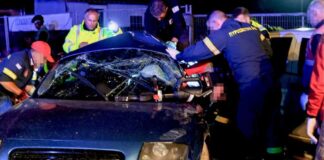
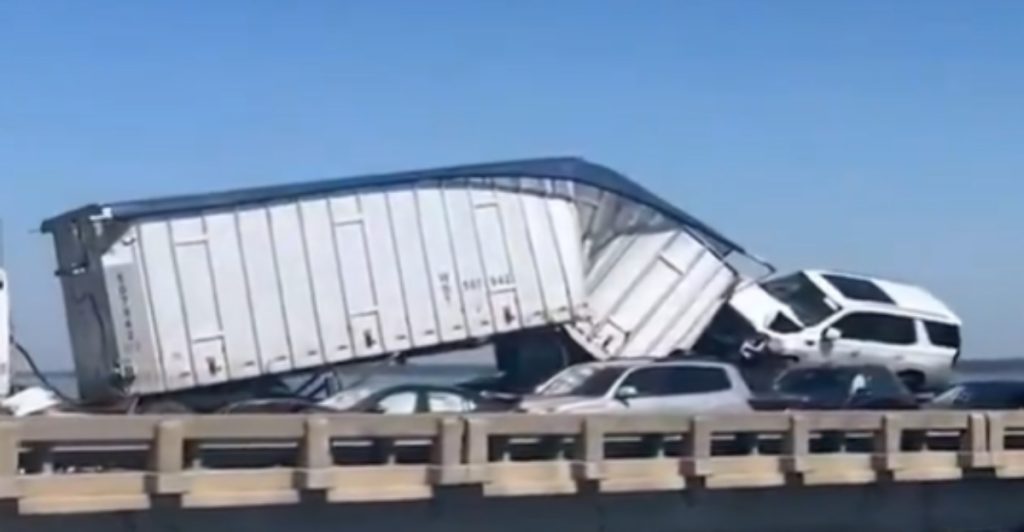
The pileup began shortly before 9 a.m. on Thursday, on the bridge where I-95 crosses Lake Marion, near mile marker 100, at the border of Clarendon and Orangeburg counties. When the first responders arrived, they were met with a scene that is difficult to describe. Fifteen trucks had been reduced to wreckage. Fifty more vehicles were wedged under the trucks or piled on top of each other. Some had caught fire. Smoke from the engines mixed with the fog, creating a suffocating blend that hampered the work of the firefighters.
By late afternoon, the toll stood at 69 vehicles in total, according to the latest updates from local authorities. Four people were trapped in the wreckage. Firefighters had to intervene to extricate them. One injured person was airlifted to a hospital, while about eleven others were transported by ambulance with lighter injuries. There were no fatalities. According to rescue workers, this was due more to luck than to planning.
The testimonies of those who found themselves in the chaos are revealing. Noah Mandel, a driver from Virginia traveling with his family to Florida, described the moment of the collision to local network WIS:
“It was crazy. It’s one of those things you don’t believe will happen to you. You saw a car behind you start smoking and catching fire. You saw people ahead of you trapped in their cars and you just wondered what you were going to do next.”
Mandel added that he thought about how close they came to falling into the lake: “It crossed my mind how lucky we were that no one went off the edge into the water.”
Mike Faucette, a local resident, heard the sound of destruction from his home. “It was people crashing into each other and the noise was deafening,” he said. “It’s the worst thing I’ve ever seen.”
Traffic on the highway was paralyzed. The southbound lanes of I-95 were completely shut down for hours. Miles-long queues formed, with vehicles at a standstill from mile marker 97 to 102. Authorities rerouted traffic via exit 102. The northbound lanes opened earlier, but at low speeds. Corporal Nick Pye, a spokesman for the South Carolina Highway Patrol, appeared in a video posted on social media to explain the situation: “We wanted to show you firsthand what first responders are dealing with. We are working with tow truck drivers to remove the vehicles. We have to do it safely, to keep the responders safe too. We are doing everything we can to get the road open as soon as possible. Avoid the area at all costs.”
The cause of the pileup is attributed to dense fog. According to meteorologist Jonathan Belles, visibility dropped below 400 meters at times. “The fog over Lake Marion formed early in the morning and dissipated around 10 a.m.,” he explained. “It is more common in the fall, when cooler air meets the humidity of summer. It appears mainly in the morning hours and in areas near lakes and rivers, where humidity is locally higher.” Authorities have not announced whether the fog was the sole cause or whether other factors, such as speed or following distance, contributed. The investigation is ongoing.
This particular bridge, however, is known for its danger. It is one of the busiest sections of I-95, with an average of about 40,000 vehicles per day. It serves as a key hub for freight transport along the East Coast and is simultaneously a critical evacuation route in the event of hurricanes. A project worth nearly half a billion dollars is currently underway to replace the two bridges with a single unified structure.
Congresswoman Nancy Mace, who represents the area in Congress, issued a statement saying: “Lives can change in an instant, and today they did. What began as an ordinary commute for hundreds of South Carolinians and travelers quickly turned into a horrific scene.” In her statement, she thanked the responders and urged drivers to follow the instructions of authorities.
The coming days will show whether the investigation will reach conclusions about the causes and whether the state will proceed with measures – such as early fog warning systems or stricter speed rules on the bridge. For the people who were at mile marker 100 that morning, the question is different. They were there. They lived it. And none of them expected that a drive to Florida or a commute to work would end in a fight for survival on a bridge, with the lake below and wreckage all around them.